Thursday, January 16, 2014

From Egypt via Iran

There are definitely some very interesting things going on in Egypt. This is one Nation that may lead the way as the "Arab Spring" sorts out its revolutions and gets better organized. Perhaps, as go the Egyptians, so goes the entire Middle East and Northern Africa.


BY JOSH ROGIN, OCTOBER 19, 2012 - 12:15 PM   

A poll of Egyptians conducted last month shows that they have increasingly positive views of Iran, believe that both Iran and Egypt should obtain nuclear weapons, and still trust their own military more than any other institution in Egypt.
Armageddon!


The poll of 812 Egyptians, half of them women, was conducted in a series of in-person interviews by the firm Greenberg Quinlan Rosner and sponsored by the Israel Project, a pro-Israel advocacy organization with offices in Washington and Jerusalem. According to the poll, Iran is viewed favorably in Egypt, with 65 percent of those surveyed expressing support of the decision to renew Egypt-Iran relations and 61 percent expressing support of the Iranian nuclear project, versus 41 percent in August 2009.

Sixty-two percent of those polled agreed that "Iran and its president, Mahmoud Ahmadinejad, are friends of Egypt," though 68 percent held unfavorable views of Shiite Muslims.
Iran's deputy defense minister said recently that the Iranian regime is seeking more military cooperation with Egypt. "We are ready to help Egypt to build nuclear reactors and satellites," he said on the occasion or Egyptian President Mohammed Morsy's meeting with Iranian President Mahmoud Ahmadinejad last month. Morsy's office has said the two didn't discuss military cooperation.

Eighty-seven percent of respondents want Egypt to have its own nuclear bomb.
Israel Project CEO Josh Block told The Cable that the statistics show the effect of Morsy's outreach to Iran and the danger of regional proliferation of nuclear weapons if Iran is successful in obtaining a nuclear bomb.

"Very scary to people opposed to proliferation of nuclear weapons, let alone to unstable countries in the world's most turbulent part of the world, is the 87 percent who want Egypt to build nuclear weapons," he said. "Morsy's dangerous embrace of Iran is leading a surprising shift in favor support for Tehran, which has for decades been seen by Egyptians as their top threat, as well as for their work on nuclear weapons."

Egyptians are overwhelmingly focused on the dire state of their domestic economy. Only 2 percent of those polled said that "strengthening relations with other Muslim countries" should be one of Morsy's top two priorities, and 45 percent agreed with the statement that "Egypt needs to focus on things at home and should be less involved in regional politics."

Nevertheless, 74 percent of those polled said that disapprove of Egypt having diplomatic relations with Israel -- an increase from 26 percent in August 2009 -- and support for a two-state solution to solve the Israeli-Palestinian conflict is at only 30 percent. Seventy-seven percent agreed that "The peace treaty with Israel is no longer useful and should be dissolved."
Block blamed that result at least partially on the stance of leading Egyptian politicians like President Morsy, who has indicated recently he does not plan to abrogate the Israel-Egypt peace treaty but whose Muslim Brotherhood party identifies Israel as a racist and expansionist state.
"The fact that Morsy and other leading politicians in Egypt regularly express disdain for the peace treaty leads to such decay in public attitudes," Block said. "Then again, nearly half the public voted for a presidential candidate who openly declared his intent to travel to Israel and support for the Camp David accords."

Block was referring to retired Air Force general Ahmed Shafiq, who served as prime minister under Hosni Mubarak and was defeated narrowly in a runoff election earlier this year.
The poll found that 64 percent of Egyptians still feel warmly about the Supreme Council of the Armed Forces, which ran Egypt in the interim period before Morsy was elected, and 81 percent approve of the job they are doing. Forty-nine percent of Egyptians polled felt warmly about Morsi, and 43 percent felt warmly about the Muslim Brotherhood.

Forty percent felt warmly about the Muslim Brotherhood's Freedom and Justice Party, but only 11 percent felt warmly about the Salafist Nour Party, a hard line Islamist party that fared well in the parliamentary elections.

American politicians fared poorly in the poll, but among them Secretary of State Hillary Clinton was the most popular at 25 percent favorability. President Barack Obama scored 16 percent and Republican nominee Mitt Romney only 8 percent, although only half of Egyptians polled knew who Romney was. (Ahmadinejad's favorability rating? Forty-three percent.)
WON'T YOU BE MY NEIGHBOR?

Most Egyptians don't seem to buy Romney's line that Obama has "thrown Israel under the bus," but they're not too happy about his handling of the region, either.

Asked, "Do you think that President Barack Obama is more on the side of Arabs or more on the side of Israel?," 68 percent of Egyptians said Israel, and 60 percent said that Obama's presidency had been "a negative thing" for the Arab world.
39% of the Egyptians polled expressed interest in learning more about Israel, especially its political system. The Israel Project runs an outreach program to the Arab world, focusing on social media. Its Facebook page is called "Israel Uncensored."


Source:


Big money behind war: the military-industrial complex

- I hate to say, “I told you so!”, 

but the truth will always come out


More than 50 years after President Eisenhower's warning, Americans find themselves in perpetual war.
Jonathan Turley is the Shapiro Professor of Public Interest Law at George Washington University and has testified before Congress on the dangerous expansion of presidential powers.


In January 1961, US President Dwight D. Eisenhower used his farewell address to warn the nation of what he viewed as one of its greatest threats: the military-industrial complex composed of military contractors and lobbyists perpetuating war.

Eisenhower warned that "an immense military establishment and a large arms industry" had emerged as a hidden force in US politics and
that Americans "must not fail to comprehend its grave implications". The speech may have been Eisenhower's most courageous and prophetic moment. Fifty years and some later, Americans find themselves in what seems like perpetual war. No sooner do we draw down on operations in Iraq than leaders demand an intervention in Libya or Syria or Iran. While perpetual war constitutes perpetual losses for families, and ever expanding budgets, it also represents perpetual profits for a new and larger complex of business and government interests.

The new military-industrial complex is fueled by a conveniently ambiguous and unseen enemy: the terrorist. Former President George W Bush and his aides insisted on calling counter-terrorism efforts a "war". This concerted effort by leaders like former Vice President Dick Cheney (himself the former CEO of defense-contractor Halliburton) was not some empty rhetorical exercise. Not only would a war maximize the inherent powers of the president, but it would maximize the budgets for military and homeland agencies.

This new coalition of companies, agencies, and lobbyists dwarfs the system known by Eisenhower when he warned Americans to "guard against the acquisition of unwarranted influence… by the military-industrial complex". Ironically, it has had some of its best days under President Barack Obama who has radically expanded drone attacks and claimed that he alone determines what a war is for the purposes of consulting Congress.

Investment in homeland security companies is expected to yield a 12 percent annual growth through 2013 - an astronomical return when compared to other parts of the tanking economy.

Good for economy?
While few politicians are willing to admit it, we don't just endure wars, we seem to need war - at least for some people. A study showed that roughly 75 percent of the fallen in these wars come from working class families. They do not need war. They pay the cost of the war. Eisenhower would likely be appalled by the size of the industrial and governmental workforce committed to war or counter-terrorism activities. Military and homeland budgets now support millions of people in an otherwise declining economy. Hundreds of billions of dollars flow each year from the public coffers to agencies and contractors who have an incentive to keep the country on a war-footing - and footing the bill for war.


Across the country, the war-based economy can be seen in an industry which includes everything from Homeland Security educational degrees to counter-terrorism consultants to private-run preferred traveler programs for airport security gates. Recently, the "black budget" of secret intelligence programs alone was estimated at $52.6bn for 2013. That is only the secret programs, not the much larger intelligence and counterintelligence budgets. We now have 16 spy agencies that employ 107,035 employees. This is separate from the over one million people employed by the military and national security law enforcement agencies.

The core of this expanding complex is an axis of influence of corporations, lobbyists, and agencies that have created a massive, self-sustaining terror-based industry.

The contractors
In the last eight years, trillions of dollars have flowed to military and homeland security companies. When the administration starts a war like Libya, it is a windfall for companies who are given generous contracts to produce everything from replacement missiles to ready-to-eat meals.

In the first 10 days of the Libyan war alone, the administration spent roughly $550m. That figure includes about $340m for munitions - mostly cruise missiles that must be replaced. Not only did Democratic members of Congress offer post-hoc support for the Libyan attack, but they also proposed a permanent authorization for presidents to attack targets deemed connected to terrorism - a perpetual war on terror. The Department of Homeland Security (DHS) offers an even steadier profit margin. According to Morgan Keegan, a wealth management and capital firm, investment in homeland security companies is expected to yield a 12 percent annual growth through 2013 - an astronomical return when compared to other parts of the tanking economy.

The lobbyists 
There are thousands of lobbyists in Washington to guarantee the ever-expanding budgets for war and homeland security. One such example is former DHS Secretary Michael Chertoff who pushed the purchase of the heavily criticized (and little tested) full-body scanners used in airports. When Chertoff was giving dozens of interviews to convince the public that the machines were needed to hold back the terror threat, many people were unaware that the manufacturer of the machine is a client of the Chertoff Group, his highly profitable security consulting agency. (Those hugely expensive machines were later scrapped after Rapiscan, the manufacturer, received the windfall.)

Lobbyists maintain pressure on politicians by framing every budget in "tough on terror" versus "soft on terror" terms. They have the perfect products to pitch - products that are designed to destroy themselves and be replaced in an ever-lasting war on terror. 

The agencies 
It is not just revolving doors that tie federal agencies to these lobbyists and companies. The war-based economy allows for military and homeland departments to be virtually untouchable. Environmental and social programs are eliminated or curtailed by billions as war-related budgets continue to expand to meet "new threats".

A massive counter-terrorism system has been created employing tens of thousands of personnel with billions of dollars to search for domestic terrorists.

With the support of an army of lobbyists and companies, cabinet members like former DHS Secretary Janet Napolitano, are invincible in Washington. When citizens complained of watching their children groped by the TSA, Napolitano defiantly retorted that if people did not want their children groped, they should yield and use the unpopular full-body machines - the machines being sold by her predecessor, Chertoff. 

It is not just the Defense and DHS departments that enjoy the war windfall. Take the Department of Justice (DOJ). A massive counter-terrorism system has been created employing tens of thousands of personnel with billions of dollars to search for domestic terrorists. The problem has been a comparative shortage of actual terrorists to justify the size of this internal security system. 

Accordingly, the DOJ has counted everything from simple immigration cases to credit card fraud as terror cases in a body count approach not seen since the Vietnam War. For example, the DOJ claimed to have busted a major terror-network as part of "Operation Cedar Sweep", where Lebanese citizens were accused of sending money to terrorists. They were later forced to drop all charges against all 27 defendants as unsupportable. It turned out to be a bunch of simple head shops. Nevertheless, the new internal security system continues to grind on with expanding powers and budgets. A few years ago, the DOJ even changed the definition of terrorism to allow for an ever-widening number of cases to be considered "terror-related".

Symbiotic relationship
Our economic war-dependence is matched by political war-dependence. Many members represent districts with contractors that supply homeland security needs and our on-going wars.

Even with polls showing that the majority of Americans are opposed to continuing the wars in Iraq and Afghanistan, the new military-industrial complex continues to easily muster the necessary support from both Democrats and Republicans in Congress. It is a testament to the influence of this alliance that hundreds of billions are being spent in Afghanistan and Iraq while Congress is planning to cut billions from core social programs, including a possible rollback on Medicare due to lack of money. None of that matters. It doesn't even matter that Afghan President Hamid Karzai has called the US the enemy and said he wishes that he had joined the Taliban. Even the documented billions stolen by government officials in Iraq and Afghanistan are treated as a mere cost of doing business.

It is what Eisenhower described as the "misplaced power" of the military-industrial complex - power that makes public opposition and even thousands of dead soldiers immaterial. War may be hell for some but it is heaven for others in a war-dependent economy.

Jonathan Turley is the Shapiro Professor of Public Interest Law at George Washington University and has testified in Congress on the massive counter-terrorism budgets and bureaucracy in the United States.
*The views expressed in this article are the author's own and do not necessarily reflect Al Jazeera's editorial policy.

Source:


http://www.aljazeera.com/Media/ver2/Images/1pximage.png

Sunday, January 12, 2014

“Recent al-Qaida push stresses LI Iraq War vets” – NEWSDAY


My friend, Martin Evans, is keeping the flame alive, as he reports on the plight of Long Island’s Veteran population. His most recent article, below, helps to give some insight to the feelings of frustration and anger that our OIF & OEF Veterans are currently experiencing. The old guard, Viet Nam Veterans, had a similar feeling of despair, frustration, anger, and mistrust after the fall of South Viet Nam in 1975. I am honored with the opportunity to walk among some of our newly returned Veterans, and I am equally saddened by what they are going through in their battle to re-enter civilian life. As Mr. Evans has reported before, the suicide rate for our younger Veterans is climbing at alarming speed. It is now true that the primary cause of death for Soldiers and Veterans is suicide, not being in battle. Thank you Martin, for keeping this subject on the radar.
I sincerely hope that the United States of America comes to its senses, and stops making Veterans.

Originally published: January 9, 2014 7:53 PM
Updated: January 9, 2014 9:27 PM
By MARTIN C. EVANS (click)
martin.evans@newsday.com

   Photo credit: Newsday / John Paraskevas | Francis Romanitch,
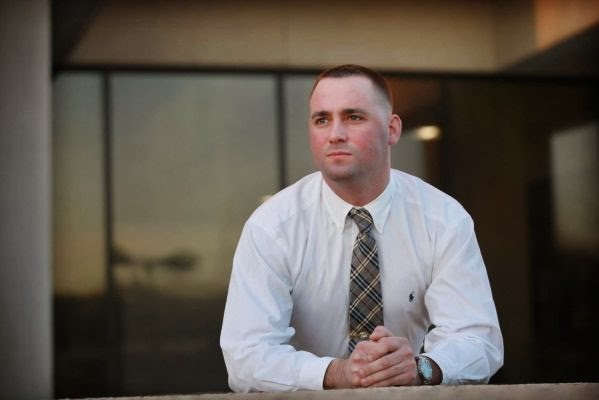
   a Marine Corps reservist who helped pacify Anbar Province
   when he served in Iraq. (Jan. 9, 2014)

The al-Qaida takeover of parts of Iraq's Anbar province, where about a third of American troops killed in the war perished, has left area Iraq War veterans bitterly wondering what their sacrifice was all about.

"It's disheartening," said Francis Romanitch, 28, a Marine Corps reservist who served in the Anbar city of Ramadi in 2004 as Marines fought door-to-door 25 miles away in Fallujah.It’s like seeing the Japanese flag flying over Iwo Jima 10 years after World War II," said Romanitch, of Babylon.

Last week, al-Qaida-linked forces overran parts of Fallujah and Ramadi, commandeering police and military facilities, and setting up armed checkpoints. The White House has ruled out resending U.S. troops -- who withdrew from Iraq in 2011 -- but is providing the Iraqi government with arms.

Beginning in 2004, Anbar, a Sunni power base for Iraqi dictator Saddam Hussein before his capture, became the scene of some of the bloodiest confrontations during the war.

After insurgents hung the burned bodies of four American contractors from a bridge in Fallujah, U.S. troops that April rooted out opponents during weeks of door-to-door confrontations. But they paid a horrific price, according to historian Richard Lowry, author of the book "New Dawn: The Battles for Fallujah."

"These young Marines -- 19 years old -- went in every building and every room of Fallujah," Lowry told Fox News. "They entered darkened rooms, kicking down doors, never knowing if they would find an Iraqi family hunkered down in fear or an Islamist terrorist waiting to shoot them and kill them. And they did that over and over and over again."

Mental health workers have said witnessing a military collapse can be emotionally traumatic for war veterans regardless of what conflict they fought in.

"It's re-traumatizing, if you will," said Denis Demers, who served as a psychological medic in Vietnam and now counsels veterans at the Suffolk Veterans Service Agency.

In 2004, Michael Posner was stationed in Mosul with a New York National Guard unit when a bomb ripped through a military mess tent, riddling him with shrapnel and killing 14 fellow soldiers. He said watching parts of Iraq slip under insurgent control weighs heavily on him.

"It brings back a lot of memories and flashbacks," said Posner, 43, of Bellport. Feelings of anxiety, depression and anger spawned by his wartime experience for a while pushed  him to abuse alcohol and cost him his marriage.

"I lost a part of my soul over there," he said.

Posner, who since returning from Iraq has helped counsel fellow soldiers suffering from anxiety attacks, said he's recently received phone calls from veterans expressing rage.

"A lot of these guys lost a lot of their buddies and saw a lot of bloodshed," he said. "There was so much work they did, and it's gone to hell."

Scott Molloy, 29, of Kings Park, who served in Afghanistan in 2012, said the feeling of accomplishment he had over there has turned to disillusionment. Molloy has struggled to control feelings of anger and frustration related to post-traumatic stress disorder. He said those feelings have worsened because of the al-Qaeda surge.

"It hits you like a ton of bricks," he said. "You ask yourself, 'Why did I go through all that? Why am I suffering?' "d him to abuse alcohol and cost him his marriage.

Galleries:
(click)Honoring Long Island's veterans 
(click)Military heroes return to Long Island


(click)LI, NYC war casualties
(click)LI troops who died in war


Monday, December 23, 2013

Truth & consequences


 Actions have consequences, intended, or not. The statement of discovery, below, is a solid insight into how our politicians in Washington time and again hold themselves above the law. And, our democracy depends on law to see to it that democracy actually works. It’s sort of that way by design. 

Now, on matters political, Mrs. Feinstein has held a fairly good record throughout her tenure. When we, the electorate, see one of our elected officials falling over into the dark side, we have a Constitutional duty to send said politician packing. This is the biggest argument for term limits at every level of governance. The longer they stay glued to seats in Washington, the more insidious the greed becomes, and deals like the one mentioned below take place without the batting of an eyelash. On the matter of Blum/Feinstein being “two public service crooks, I believe the Blum side of the equation is in the privet sector, not the public sector.
 
But, all that aside, let’s get to the core of the argument. You may start by asking, “Why would a commercial, private sector company want a barrel full of old Post Office buildings?” Start by looking back in time when the USPS was at the top of its game, and there were a slew of “overnight” courier services available for substantially higher prices. Those courier companies morphed into United Parcel Service (UPS), Federal Express (FedEx), DHL, and a few lesser players.

Their business models have outstripped the Post Office in performance, not only in the domestic market, but also in the international market. I have to believe that this has not occurred without the wheeling and dealing of Big Business. To set the record straight on some facts quoted below, the USPS is not mismanaged. It has been under the thumb of an unrelenting Congress for the last forty odd years. The USPS has been literally robbed of its revenue by acts of Congress, and that is why they are in such financial chaos. The government mandates on their pension system add untold “on paper” losses that keep the USPS in the red.


Now, along come the aforementioned “courier” companies who have set their eyes on the entire mail and package delivery system, worldwide. If the business lobby can force the USPS to go under, their clients can walk right in without firing a shot, and take over the entire show. That’s how capitalism works, when greed is King. So, the number quoted below, $117 billion in the last ten years, is not a very surprising amount.


*********************************************************************************
The US has entered into a contract with a real estate firm to sell 56 buildings that currently house U.S. Post Offices. The government has decided it no longer needs these buildings, most of which are located on prime land in towns and cities across the country. The sale of these properties will fetch about $19 billion. A regular real estate commission will be paid to the company that was given the exclusive listing for handling the sales. That company is CRi and it belongs to a man named Richard Blum.“Richard Blum is the husband of Senator Dianne Feinstein and is shown with her in the picture above. (Most voters and many of the government people who approved the deal have not made the connection between the two because they have different last names). Senator Feinstein and her husband stand to make a fortune (at between $950 million and $1.1 billion!!) from these transactions. His company is the sole real estate agent on the sale. CRI will be making a minimum of 3% and as much as 6% commission on each and every sale. All of the properties that are being sold are all fully paid for. They were purchased with U.S. taxpayers dollars.”“Well, the folks in Washington have given the Post Office the OK to do it! Worse yet, most of the net proceeds of the sales will go back to the U.S.P.S, an organization that is so poorly managed that they have lost $117 billion dollars in the past 10 years! No one in the mainstream media is even raising an eyebrow over the conflict of interest and on the possibility of corruption on the sale of billions of dollars’ worth of public assets. How does a U.S. Senator from San Francisco manage to get away with organizing and lobbying such a sweet deal? Has our government become so elitist that they have no fear of oversight? And it's no mere coincidence that these two public service crooks have different last names; a feeble attempt at avoiding transparency in these type of transactions. Pass this info on before it's pulled from the Internet. I even verified it on Snopes:” http://www.snopes.com/politics/business/blum.asp
And, Snopes usually puts a liberal spin on whatever it reports. It also was verified on TruthofFiction.com, which is a more reliable source for checking Internet rumors. You can read what they said by clicking on:”  http://www.truthorfiction.com/Blum-Post-Office-Sale-061013.htm“Now, here's the test.”“The U.S.P.S. is allowed free and clear, tax exempt use. The only cost to keep them open is the cost to actually keep the doors open and the heat and lights on. The United States Postal Service doesn't even have to pay county property taxes on these subject properties.”             “QUESTION?”                    “Would you put your house in foreclosure, just because                                    you couldn't afford to pay the electric bill?” 

 “DOES THIS PISS YOU OFF?
 “If it doesn't, then don't complain about the corruption and the ineptness in D.C. You apparently have given up or have turned a blind eye and don't care.

Sunday, December 15, 2013

The second amendment doesn’t work anymore! So, let’s get rid of it.

As ratified by the States and authenticated by Thomas Jefferson, then-Secretary of State: [24]
A well regulated militia being necessary to the security of a free state,
the right of the people to keep and bear arms shall not be infringed.

If the original intention of Amendment II of our Constitution was properly executed, there would be no Grand National discourse as to how many, and what type of, guns a civilian might be “allowed” to have.

Ideals that helped to inspire the Second Amendment in part are symbolized by the minutemen. [41]
                                                                                       41.  Cornell, Gun Control, p. 2
This little piece of our National Constitution in no way mandates that every household in the Country has to have firearms. 

The existence of this Amendment grants only the “right” to “keep and bear arms”, not a mandate that every household needs to be armed to the teeth.

If you interpret this Amendment as it was most probably intended, you can easily come to the conclusion that the British, French, Indians, and Spanish are not going to storm our shores, loot, pillage, plunder and rape any time in the foreseeable future. Based on the size of our National arsenal, I would venture a guess that, save the lone terrorist group, no one will ever attempt to overrun our borders using lethal force.

I know the theory of “monkey see; monkey do” is a statistically valid theory. This is pointed out by the fact that our Nation has been involved in 166 incidents of armed conflict over its 248 year history. That translates into 1 ½ such conflicts/wars every year of existence as a sovereign Nation.

The United States ranks first in a good number of categories. The fact that we seem to like to shoot first and ask questions later might be a category we no longer need to be the best at.

The United States has, for quite some time, had the absolute best Military of any Nation in the history of man. This is a position that is part of our national DNA. We tend to enjoy protecting ourselves against any enemy anywhere in the World. This is not a bad thing, until you start pulling the trigger as often as we seem to.

What does this have to do with our 2nd Amendment? What our elected officials do by waging war so often, on our behalf, has been replicated in the people’s psyche. It’s as if we all want to be G.I. Joe, or Rambo. Civilian life isn’t supposed to be like that; hence the definition of the word “civil” (Go ahead, look it up. I dare you.).

Since there is no one about to huff and puff and blow your house down, we should get rid of this 2nd Amendment completely. It has outlived its usefulness, and has, indeed, become a detriment to life as it should be.

Is it really our intention, as a people, to run around shooting our children let alone each other? Can’t we leave the shooting to those we ask to protect us? Let’s get rid of our paranoia and, at the same time, lose the 2nd Amendment.